
Comedy as Philosophy
Every joke gives you something. Actually, only one of four things: laughter, opportunity for self-reflection, self-awareness that you are boring, or dumb. Either way, it's a win-win-win-win situation.

The moment of laughter is magical. When you are in the middle of a laugh, in that very moment, it is impossible for worry, anxiety or grief to exist inside your body. It can exist before or after, but not during. Laughter is one of the purest physiological responses a human body can produce. In that ephemeral moment of laughter, you aren’t right-wing, left-wing, liberal, conservative, pro-life, pro-choice, or any of the -isms you may subscribe to. You are just one with your true self, and with the joke that produced the laughter. How magical.
Of all things that piss me off about our culture (there are many), the thing that pisses me the most is when we ban comedy. Comedians are not only professional laughter producers, but also the clearest thinkers and communicators of our culture. Because, to make someone laugh about something, a comedian doesn’t only need to observe and understand the thing very closely, but also re-imagine it in a way that makes another human respond emotionally, through a laugh. It’s no wonder that the most incisive insights about the human condition that make you stop in your tracks come, not from TED sessions, but from standup comedians (think Ricky Gervais, Dave Chappelle, Hannah Gadsby, Zakir Khan, Jerry Seinfeld).
Every joke gives us something. Our response to a joke is revelatory of our inner worlds. Let me break it down via The Laughter-Guilt Matrix (or The LauG Scale)TM :
When we hear a joke, we either laugh spontaneously, or not. Once the spontaneous laughter has begun, we either feel guilty about our own laughter (or non-laughter) or we don’t. All jokes in the world, and our response to them fall within this joke-space.
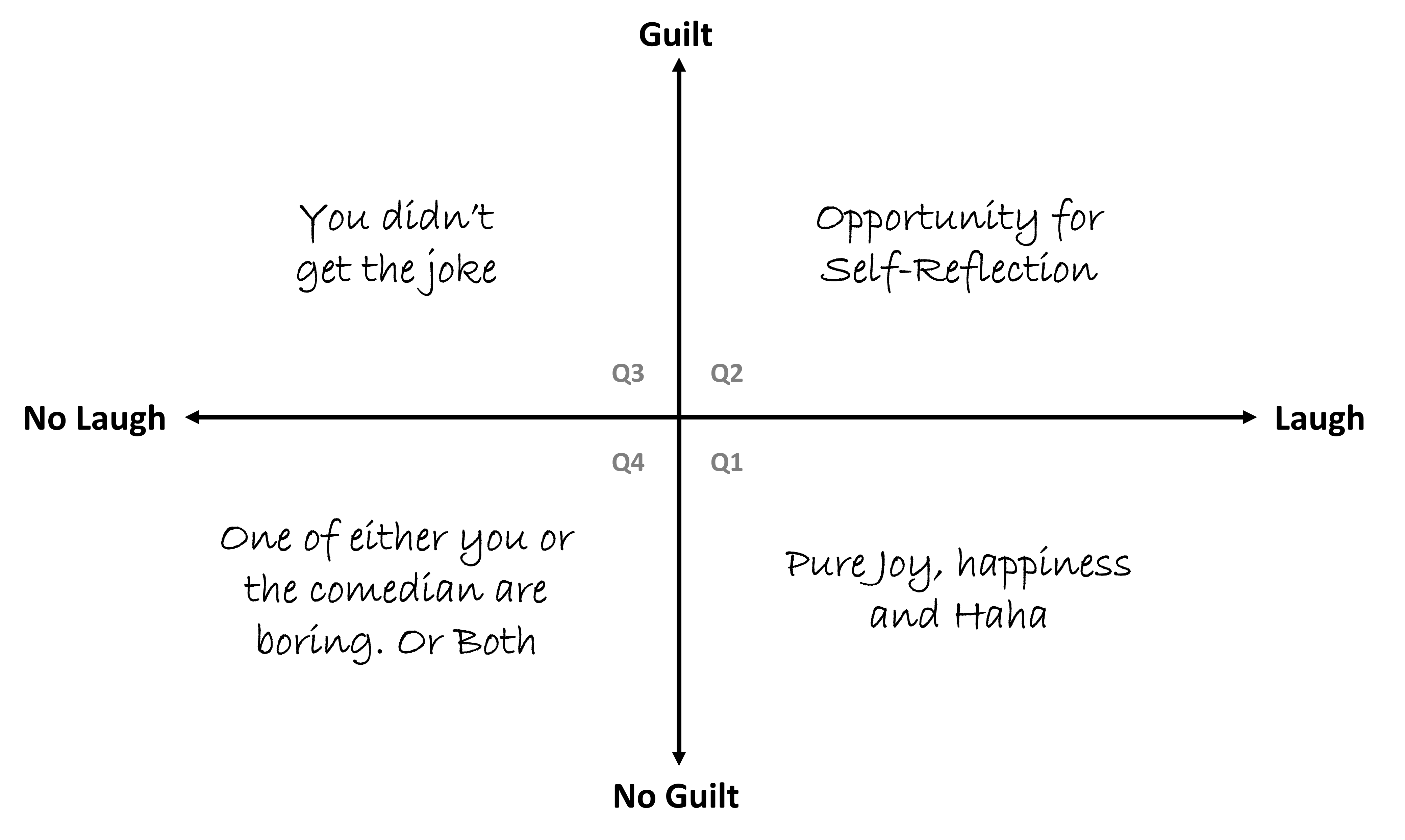
Let’s examine each quadrant closely.
Q1: You laugh, and feel no guilt. What’s there to examine? Best thing ever.
Q2: You laugh spontaneously, but feel guilty right after. This means that within you live two rivalling thoughts. Your body has produced a genuine laughter - a seal of approval- upon hearing a joke, but your mind has judged your body for laughing. This usually happens when we hear politically incorrect jokes. It is a moment to self-reflect. Because what you ‘believe’ or ‘think’ hasn’t percolated deep inside your consciousness. This is an opportunity to either re-examine your belief system or imbibe it deeper. Either way, time to reflect.
Q3: You didn’t laugh, and are now feeling guilty for not laughing, probably because you see others around you laughing. You clearly didn’t get the joke. You are dumb. There’s nothing you can do about it. But at least now you know that you are dumb. That makes you less dumb. You should thank the comedian.
Q4: You didn’t laugh and are not feeling guilty for not laughing. In most cases, it’s a bad joke. Ask for your money back. But if others around you are laughing, and you have a smug expression on your face, it’s likely that you are a super-boring person. Or you are a very conscientious person, with the most moral set of personal politics, a very good human being with zero internal contradictions and dead-sure about what’s right and what’s wrong. In other words, boring.
There’s so much to gain and learn from comedy. So let’s not ban it. Ludwig Wittgenstein once said that the most serious issues can only be dealt and understood through the form of comedy. I hope you find it in yourself to laugh freely. If not, you might want to consider marriage.







Disclaimer: Yes, I got the naming of the quadrants wrong. Congratulations for spotting it. If you have any feedback, you can click here.